

Blood Debt - Chapter Two
Dark Romance, Gay Erotica, +18

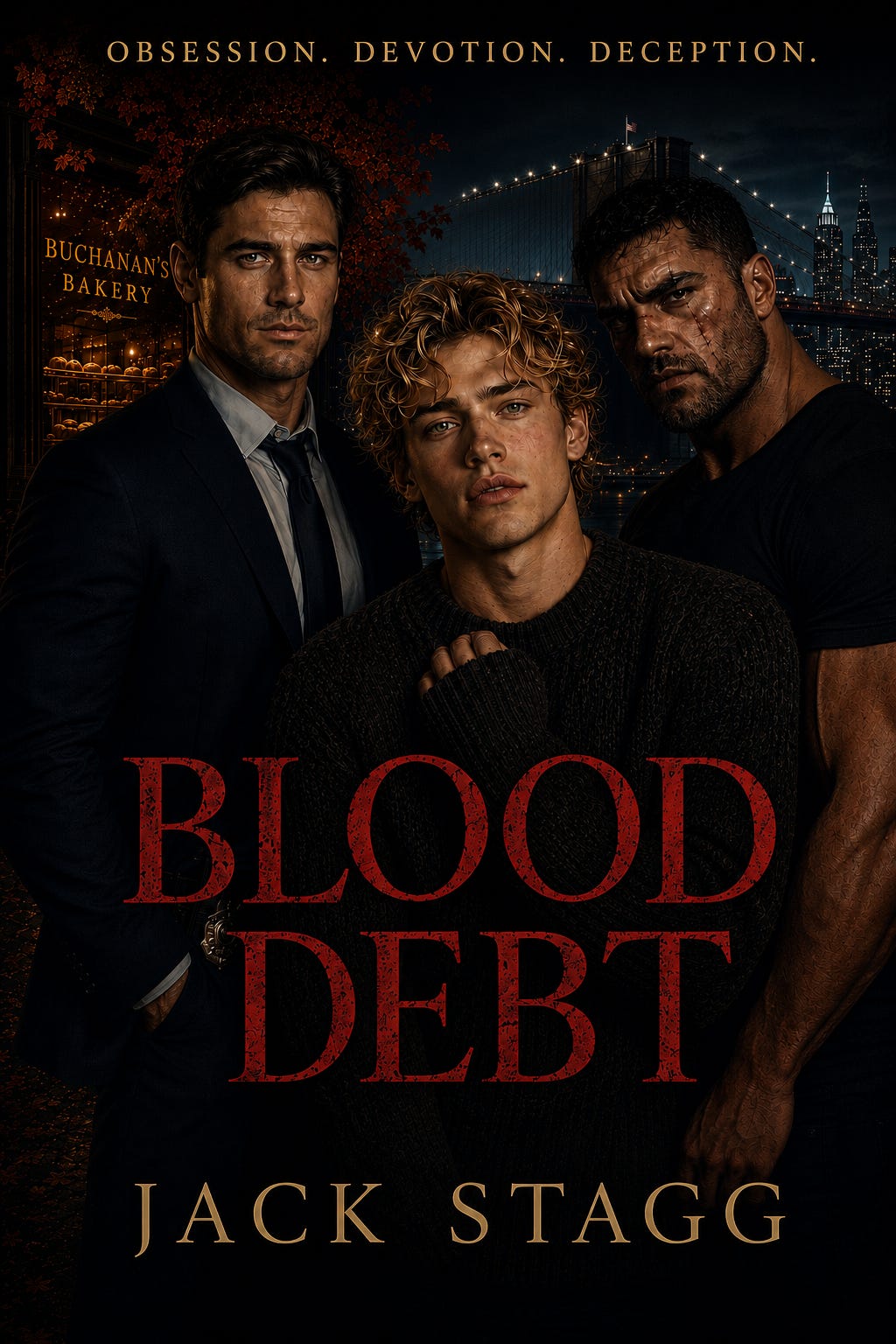
It was cold and silent when Oliver opened his eyes the next morning. Five o’clock. The alarm was set for five-fifteen, so he lay still for a moment, eyes open in the dark, feeling the weight of the morning settling on the apartment. The fireplace embers had held through most of the night, but the cold had found the gaps anyway — between the sheets and the air, between the warmth and the windows, between the place on the mattress where Oliver lay and the place where another body should have been and wasn’t.
Oliver hated sleeping alone when it was cold like this.
He’d never say so, to Trevor, who would feel guilty, or Lily, who would worry, or anyone at all, but the truth lived in his body whether he spoke it or not. He’d migrated to the center of the bed during the night, pulling the quilt tighter, curling inward. Marshmallow was pressed against his chest, a small furnace of white fur, purring faintly in his sleep. Oliver’s hand was still resting on the cat’s side where it had been when he’d fallen asleep.
The sky through the bedroom window was not quite dark, not quite light, but something in between. The sun was coming but it hadn’t committed yet, just a thin line of amber at the very edge of Brooklyn, barely visible between the buildings. Oliver watched it for a moment. The slow arrival of a day that hadn’t asked to be born.
He sat up. Marshmallow chirped in protest and resettled himself on the warm patch Oliver’s body had left behind. Oliver ran a hand over the cat’s back.
“I know,” he murmured. “Five more minutes for you.”
The shower was almost too hot and Oliver stood under it longer than he needed to, letting the water beat against his shoulders, his neck, the tight muscles along his spine that never fully loosened no matter how much yoga he did. The bathroom filled with steam. The cold retreated to the edges of the room and waited. After drying off, he pulled on a pair of soft joggers and a long-sleeved cotton shirt. He wiped the mirror clean with his palm and combed his fingers through his wet curls, letting them fall where they wanted to. There was a time in his life when his morning routine had included a pressed shirt, a name badge, a stethoscope slung around his neck like a medal. He tried not to think about that. Most mornings he succeeded.
The living room was dim and cool and smelled faintly of last night — woodsmoke, fig from the burned-down candles, and beneath it, stubborn and sweet, the permanent ghost of the bakery rising through the floorboards. Oliver knelt in front of the fireplace and rebuilt the fire, kindling first, then two small logs from the stack beside the hearth, then the match. Then he unrolled his yoga mat in front of the fireplace while the flames caught. Oliver moved through his practice in silence, no music, no guided voice, just the sound of his own breathing and the soft pop and hiss of the fire. Sun salutations first, because his body craved the stretch after a cold night. Then standing poses, warrior one, warrior two, triangle, each one held longer than was comfortable because Oliver had learned a long time ago that the space between comfort and discomfort was where the useful things lived. His breathing was steady. His focus was absolute. For twenty minutes, Oliver existed entirely inside his own body, which was the only place he had ever felt completely safe.
Marshmallow appeared midway through pigeon pose, padding silently from the bedroom and sitting precisely at the edge of the mat. He waited until Oliver was finished — standing in mountain pose, hands at heart center, eyes closed for three final breaths — and then announced his presence with a single meow.
“Good morning to you too,” Oliver said.
He fed Marshmallow first. The cat had a specific palate. Oliver made his food from scratch, a rotation of chicken, fish, and turkey that he prepared in batches and stored in small glass containers in the fridge. This morning was salmon. Marshmallow ate and Oliver watched him for a moment, leaning against the kitchen counter, and felt the fondness that Marshmallow always pulled from him, the one affection in Oliver’s life that required no maintenance. After that, Oliver settled cross-legged on the living room floor, the fire warm against his back, and Marshmallow climbed into his lap as if this were the entire reason mornings existed. Oliver used a soft-bristled brush and worked through Marshmallow’s white coat with slow, careful strokes. The cat’s purr filled the room like a continuous note held on a cello. Oliver’s hands were gentle and thorough. He found a small tangle behind one ear and worked it free with his fingers. Marshmallow’s eyes drifted shut. His body went limp with trust.
Oliver could have stayed here. Could have sat on this floor with this fire and this cat for the rest of the morning and never opened the bakery at all. The pull was real, the gravitational drag of solitude, of the quiet, of a life so small and controlled that nothing in it could hurt him. Some mornings it was harder than others to stand up.
He stood up.
Breakfast was a fried egg cooked in olive oil on a slice of his homemade sourdough from yesterday’s bak and Half an avocado sat beside it, along with a handful of microgreens from the windowsill. He ate standing at the kitchen counter, as he always did when he was alone. Sitting by himself at a table for one felt like something Oliver preferred not to think about.
Oliver carried the coffee with him to the bedroom and drank it while he changed, swapping the joggers for brown corduroy trousers that he’d owned long enough for the fabric to go soft at the knees, and pulling an ivory fisherman’s knit sweater over his head. He pushed the sleeves past his wrists and checked himself briefly in the gilded mirror by the bedroom door. His curls were dried, falling in perfect blonde waves to the nape of his neck. His cheeks were pink from the shower and the heat of the fire. At six in the morning, he looked unfairly good for someone serving coffee to sleepy customers, like he’d stepped out of a magazine and somehow wandered behind the counter instead.
Marshmallow had resettled in his wicker bed by the fireplace when Oliver passed through the living room, curled into his perfect white circle, gearing up for another four hours of sleep, the lucky bastard. Oliver crouched down and pressed a kiss to Marshmallow’s nose. The cat looked up at him, blue eyes soft with devotion, as though Oliver hung the moon and stars himself.
“Hold the fort,” Oliver murmured.
Marshmallow purred once, softly, as if to say obviously, and closed his eyes.
Oliver took the coffee mug with him. He’d forget it somewhere in the bakery by the end of the day, on top of the flour bins, next to the register, behind the espresso machine, and it would join the other seven mugs that were perpetually lost from his cupboard, living their own quiet lives among the sourdough starters and the baking sheets until Lily gathered them all up at the end of the week with a look that said you’re a grown man, Oliver Buchanan.
He took the narrow staircase down from his apartment, the interior stairs that led directly into the bakery’s pantry. He could feel the heat of the ovens before he opened the door, a wall of warm air that met him on the landing like a welcome, carrying with it the deep smell of dough that had been proofing overnight. He pushed the door open and stepped through.
The kitchen was small and immaculate, every surface scrubbed, every tool in its place. Stainless steel countertops lined three walls, worn smooth by years of use. The two commercial ovens dominated the far wall, their heat making the air shimmer faintly near the ceiling. Open shelving held mixing bowls in descending sizes, glass jars of flour and sugar labeled in Oliver’s careful handwriting, ceramic crocks of sourdough starter — including Grandma Anne’s, the oldest, fed and alive for decades, sitting in its usual spot like a family elder. A wooden rack by the window held cooling trays. The espresso machine, the one luxury Oliver had insisted on when they’d outfitted the space, gleamed darkly in the corner. Everything was functional and nothing was ugly, because Oliver didn’t believe those two things needed to be mutually exclusive.
Lily was already there.
She was standing at the center counter with her back to him, her golden hair pulled up in a messy knot secured with what appeared to be a wooden chopstick, her hands deep in a bowl of dough. She was humming something and the sound mixed with the low hum of the ovens and the tick of the wall clock in a way that made the kitchen feel like the inside of a music box. Everyone said she was the female version of Oliver. They had the same height, the same blue eyes, the same golden hair that caught the light in the same way, the same full, pouty lip that made strangers want to tell them things.
Oliver had always thought Lily was much, much more beautiful than he was. She had a warmth in her face that Oliver knew his own lacked, a kind of light behind the features that made people gravitate toward her not because she was pretty but because she looked like she meant it. All of it. The smile, the laugh, the way she looked at you when you talked. Lily’s face had never performed a single thing in its life. Everything on it was real and you could tell and that was the difference. Lily always disagreed ardently with this assessment. “You’re literally my face, Oliver,” she’d say, waving a flour-dusted hand at him. “If I’m hot, you’re hot. That’s how twins work.”
She had dark bags under her eyes again.
Oliver noticed immediately. Nine days. He’d been counting. Nine days ago, on a morning just like this one, Oliver had come down the stairs and found Lily at the center counter and the shadows under her blue eyes had stopped him mid-step. He hadn’t thought much of it at the time. A bad night’s sleep. Sam snoring. A phone screen scrolled too late. He’d told her she looked like a cute panda, and Lily had laughed, swatted flour at his chest and five minutes later Oliver had forgotten about it entirely.
It would have stayed forgotten, except the following day, when Oliver came down the stairs and greeted Lily at the counter again, the shadows were gone. And not because she’d slept, but because she’d covered them with concealer, carefully blended, the shade just slightly off from her natural skin tone, close enough that most people wouldn’t catch it. Oliver was not most people. Oliver had spent years studying the human face in clinical settings, learning to read what skin was saying underneath what people wanted it to say.
For some reason, his sister wasn’t sleeping well. And for some reason, she didn’t want Oliver to know about it.
“Morning, sis,” he said, sliding past her to check the overnight proofing bowls lined up along the back counter, lifting the damp cloths one by one to inspect the rise.
“Morning, honey,” Lily said, pausing her work on the dough to lean over and press a kiss to his cheek. Her lips were warm and she smelled like cocoa butter and the lavender shampoo she’d been using since they were fifteen. “I seriously thought I was going to be late. My phone battery died during the night, and I only woke up because Sam’s alarm started blaring.”
Oliver hummed. So that’s why she’d forgotten the concealer. No phone alarm meant a scramble, which meant rushing through the apartment grabbing keys and shoes and wooden chopsticks for her hair, which meant the usual careful routine had been skipped entirely.
“Bad night of sleep?”
He asked very casually, eyes on the proofing bowl in front of him, fingers pressing gently into the dough to test the give. Not looking at her. He was just making conversation, not conducting an examination.
“The usual,” Lily said.
The usual. As if there were a usual. As if not sleeping well had become ordinary enough to have a category. Oliver filed that away too.
“Hey, so I was thinking,” Lily said, wiping her hands on her apron and moving to the cooling rack where croissants sat in neat rows. “We should do a pumpkin cardamom loaf for the weekend specials. Mrs. Henley from the flower shop asked me about it last week and I’ve been playing with a recipe. I think if we do a brown butter glaze and maybe some candied pecans on top—”
Oliver noticed the pivot, a practiced redirect from something she didn’t want to talk about to something she did. He let her get away with it.
“Cardamom’s tricky with pumpkin,” Oliver said, turning to face her, leaning against the counter with his coffee cradled in both hands. “Too much and it tastes like soap. What ratio are you thinking?”
“Somewhere around a teaspoon per cup of flour,” Lily said. “Maybe a touch less. I’ve been at a quarter teaspoon and it’s still too present.”
“Go to an eighth,” Oliver said. “Let the pumpkin carry it. Cardamom should be the thing you notice after.”
Lily considered this, then turned back to her mixing bowl. Oliver recognized it as agreement.
They fell into the morning from there.
He moved to the laminated dough resting overnight — croissant dough, four turns complete, wrapped in its cold slow patience. Oliver unwrapped it on the marble slab and began to roll, the pin moving in long even strokes from center outward.
The kitchen settled into quiet of two people who had long since stopped needing to announce their movements to each other, who read the shift of a body and the sound of a drawer and calibrated around it without looking up. Lily worked her pumpkin base. Oliver shaped two dozen croissants in neat curves, transferred them to the proofing trays, covered them. He checked the sourdough schedule on the small whiteboard by the door, adjusted the oven temperature based on the morning’s humidity, pulled the first financiers from the oven and set them on the cooling rack. The kitchen built its morning smell of butter browning, sugar finding warmth, the yeast doing its slow living work beneath the damp cloths on the proving shelf.
At some point, the street outside woke up. First the delivery trucks, grumbling down the avenue. Then a dog barking from an open window, a car horn answering from somewhere unseen. Metal shutters rattled upward. A cyclist shouting a warning no one seemed to heed. Snatches of conversation floated up between bursts of traffic noise. By degrees, the block assembled itself into morning, the familiar sounds of Cobbre Hill settling into its daytime voice.
“Here.” Lily appeared at his elbow with a small ceramic ramekin and a tasting spoon.
Oliver wiped his hands on his apron and took it. The filling was deep amber, thick, fragrant. He tasted it.
“Brown butter’s right,” he said. “ The cardamom is still fighting.”
“I went to an eighth.”
“Try a sixteenth. Add a pinch of white pepper, it’ll push the pumpkin forward without announcing itself.” He handed the ramekin back. “But keep the brown butter glaze. That part’s really good.”
Lily looked at the ramekin, then at him, something fond settling in her face. “You know, sometimes I forget you went to med school and not the CIA.”
Oliver laughed. The sound came out easy, the right shape for the moment. He had never forgotten. Not on a single morning behind this counter with his hands in dough instead of a chest cavity, smelling yeast instead of antiseptic. Every morning he came down these stairs and tied on this apron he was aware of what was missing. But Lily’s face was open and warm and she meant it as a compliment.
“Don’t tell the admissions board,” Oliver said.
She laughed and turned back to her counter. Oliver turned back to his croissants.
Buchanan’s Bakery opened at seven sharp.
The bakery sat on a quiet street in Cobble Hill, Brooklyn where the sidewalks were still cracked in the old way. An old maple stood beside the entrance, enormous and patient, its branches stretching upward past the awning and toward Oliver’s apartment windows, close enough in summer that he could reach out and touch the leaves. In October the tree was on fire, gold and amber and deep copper, and every morning a new scattering of leaves covered the sidewalk and collected against the door frame and drifted onto the two small café tables Oliver kept outside. The tables were empty now, their iron chairs pushed in, wearing a thin glaze of dew and fallen leaves that Oliver swept every day and the tree replaced every night. Inside was warm, that was the first thing anyone said about Buchanan’s Bakery. Edison bulbs hung from the ceiling on dark cord, their filaments glowing amber. Mismatched tables, cushioned chairs in soft grays, open shelving behind the counter, exposed brick, dried flowers, vintage prints. The bakery looked effortless, like someone charming and slightly disorganized had filled a room with beautiful things and warmth had followed naturally. It did not look like a man had spent four months engineering a space designed to make every person who walked in feel held.
Oliver unlocked the front door, flipped the hand-painted sign from CLOSED to OPEN, and stepped behind the counter where the espresso machine was already humming and the display cases were full. Croissants, financiers, sourdough rounds, the morning’s scones lined up in neat rows. He had arranged the front of house while Lily finished the baking: fresh flowers in the small ceramic jug by the register, the chalkboard menu updated in his looping handwriting, the window table wiped down for Meredith, who would arrive at seven on the dot as she had every morning for the past eighteen months and claim the seat as though the Geneva Convention entitled her to it.
Meredith was late today.
The first customer arrived at 7:02 — a kid who couldn’t have been older than nineteen, wearing a backpack half his size and the hollowed-out expression of someone who had either just finished an all-nighter or was about to start one. He ordered the strongest black coffee Oliver had, and Oliver poured him a triple-shot Americano and only charged for two, because the kid looked like he needed an intervention more than a beverage. He shuffled out into the October morning and Oliver gave him until noon before he was facedown on a library desk somewhere. The second was a finance type in a charcoal Tom Ford suit that cost more than Lily’s monthly rent, already mid-conversation on his phone about convertible notes and Series B rounds, his voice filling the small bakery like he’d been allocated more airspace than everyone else and intended to use it. He ordered something with enough specifications to qualify as a legal document, barely looked at Oliver, and left a fifteen-dollar tip on a nine-dollar order. Oliver watched him go. Anyone who tipped like that while being that obnoxious had made peace with himself in a way Oliver almost admired.
The third was a woman Oliver recognized. She’d been in twice before, lingering both times, browsing the pastry case longer than the selection required, her eyes moving across the vintage plates and the dried flowers and the Edison bulbs as if she were memorizing the room for later. They talked while Oliver prepared her order. She was a copy editor at a publishing house in Manhattan, had just moved to the neighborhood, and was already rearranging her morning commute to walk past the bakery window. Oliver listened and laughed and asked the kinds of questions that made people feel like the most interesting person in the room, which was not difficult when the person was genuinely interesting. When she reached the register, Oliver set a lavender honey latte in front of her before she’d ordered, and she blushed almost the exact shade of the peonies he had put in the ceramic jug that morning. She paid, took her usual table by the window and opened a paperback. Oliver had a feeling she’d be here next Wednesday too.
Oliver had just started to genuinely worry about Meredith, who hadn’t missed her seven o’clock window in eighteen months, when the front door swung open and Meredith Sutton pushed through it with more force than a woman of seventy-one should have been able to generate.
“Before you say anything,” she announced, unwinding a tartan scarf from her neck, “it was the cat.”
“I was about to send a search party,” Oliver said from behind the counter.
“Don’t be dramatic, sweetheart.”
Meredith crossed to her window table, the one Oliver had quietly kept clear for the past thirty-four minutes, and settled into her chair with a satisfied exhale.
“Mr. Whiskers got into the bathroom cabinet again and knocked my blood pressure pills into the toilet. I had to fish them out, dry them off, call Dr. Ortega’s office to ask if toilet pills were still medically viable, sit on hold for twenty minutes, and then get lectured by a receptionist who is younger than my winter coat.”
“And the verdict?”
“New prescription. Apparently toilet pills are not medically viable.” She folded her scarf precisely and placed it on the chair beside her. “I could have told them that. I just wanted someone official to confirm.”
Oliver set her usual in front of her — Earl Grey, splash of milk, no sugar, and a slice of lemon drizzle cake — before she’d asked for it. Meredith looked at the cup and then up at Oliver, and her face did something soft and grateful that she would have denied if anyone pointed it out.
“You’re a good boy, Oliver Buchanan,” she said.
“Don’t tell anyone,” Oliver said. “I have a reputation.”
Meredith settled into her crossword and the bakery filled in around her. More customers arrived — a couple Oliver recognized from the block, regulars who hadn’t earned names yet but who waved and ordered without checking the menu. A man in paint-spattered jeans who asked for four coffees and a bag of scones for a crew working a brownstone renovation down the street, and Oliver threw in two extra croissants, free of charge, because those guys would be starving before ten. Lily moved to the front to help with the register while Oliver restocked the display case, sliding fresh croissants into the rows where the early morning rush had left gaps. The espresso machine hissed and hummed. A grinder whirred to life, then fell silent. Ceramic knocked against ceramic. Conversation overlapped in every corner of the room, voices weaving together beneath the low thrum of music.
Oliver was happy. Or close enough to it that the difference didn’t matter.
The door opened again and the October air came in and Oliver looked up and his hands stopped. It was barely anything. A pause so brief that anyone watching would have missed it, fingers halting mid-motion on the espresso machine, a stillness that lasted less than a full breath before Oliver’s hands resumed exactly where they’d left off.
Lily saw it. Oliver felt her go still behind him at the pastry case.
Colby Davenport was tall and well-dressed in a way that stopped just short of advertisement, every piece expensive, every piece fitting perfectly, none of it requiring a second thought or a price tag check. Dark wool coat, open over a cashmere sweater, leather gloves that he pulled off one finger at a time as he approached the counter. He was handsome in a polished, maintained way, the jaw, the cheekbones, the silver threading through dark hair at the temples. Early forties. The face of a man who sat on boards and attended galas and had a family lawyer on retainer. He didn’t look around the bakery. Oliver had seen Colby walk past the window six times in the last month, slowing just enough each time for Oliver to know it wasn’t coincidence. Colby already knew what the bakery looked like. He’d already taken it in, already measured the distance between what Oliver had been and what Oliver was now. The look he gave Oliver across the counter confirmed it. So this is what you’re doing now.
He reached the counter. His eyes met Oliver’s.
“Good morning.” Oliver kept his voice steady. He wasn’t going to give this man the satisfaction of hearing anything else in it. “What can I get you?”
Colby studied him for a moment. His eyes moved over Oliver’s face with clinical attention, down across the way the fisherman’s knit filled out at the chest, along the forearms where Oliver had pushed the sleeves past his wrists, lingering briefly on the place where the wool had gone thin at the cuff from two years of flour and water and work.
“Coffee, please. Black.” The politeness was technically there, buried so far beneath the frost that it barely qualified. “And an almond croissant. Two.”
Oliver’s hands stopped on the espresso machine, just for a second, a half-beat of stillness that he folded away before it could settle on his face.
“Coming right up,” he said.
Oliver turned to the espresso machine. His shoulders were tight beneath the knit of his sweater and he could feel Colby’s eyes on his back while the coffee poured, the gaze sitting between his shoulder blades like a fingertip pressing on a bruise.
“That’s a lovely place you got here, Oliver.”
Oliver hated the sound of his own name in that mouth. The way Colby shaped it, familiar, almost fond, as if they were old acquaintances catching up over pastry. As if the last time they’d been in the same room hadn’t ended with Oliver’s life in pieces on the floor.
“Thanks,” Oliver said, without turning around.
“Really charming. The candles are a nice touch.” A pause. “Quite the change of pace from medicine.”
“Can I help you with something?” Lily’s voice came from Oliver’s left, bright and sudden. Her arms were crossed over her apron. She was smiling,and it was the worst smile Oliver had ever seen on his sister’s face. “Because if you’re just here for the coffee, it’s almost ready. And we don’t really do table service.”
They did, in fact, do table service. Oliver had insisted on it.
The bakery went just slightly quieter. Meredith still had her crossword, the couple by the wall still had their newspapers but, the frequency of the room shifted as rooms sometimes do when someone says something with a second meaning and most people can feel it even if they can’t name it.
“Lily,” Oliver said quietly.
“I’m just letting our customer know,” Lily said, her eyes still on Colby, her smile still in place.
Oliver turned from the machine. He set the coffee and the paper bag on the counter with a care that cost him something.
“Here you go,” he said. “Anything else?”
“No. That should do it.” Colby reached into his coat for his wallet. Dark leather, monogrammed. Of course it was monogrammed.
“On the house,” Oliver said.
Colby’s hand paused. The wallet stayed half-drawn, suspended between the coat and the counter. “I wouldn’t dream of it.”
“I don’t want your money.”
Something moved across Colby’s face, settling with unmistakable satisfaction of a goal achieved. His mouth curved, but it wasn’t quite a smile. Less than that and worse than that, just the corner lifting, just enough to let Oliver know it was deliberate.
“Since when are you so precious about money, Oliver?”
Lily inhaled sharply beside him. Oliver felt the sentence open up inside his chest. Everything he’d lost, everything that had been taken from him, the career, the years, the life he should have had, all of it flattened into an insinuation about money. About motive. About the kind of man Oliver Buchanan really was. Colby had taken the worst thing that had ever happened to Oliver and made it sound like a transaction.
“Anything else?” he asked again.
Colby looked at him for a long moment. Then he pulled on his leather gloves, one finger at a time, the same way he’d taken them off.
“No,” he said. “I think I got what I came for.”
He turned and walked out of Buchanan’s Bakery without touching the coffee or the almond croissants. The door closed behind him. The October air swirled in and settled. The little glass votive on the table nearest the entrance flickered once and held.
“You okay, Ollie?”
Lily’s voice came from somewhere far away. Her hand found his shoulder, warm through the wool of his sweater.
“I’m fine,” Oliver said, and even he heard how it sounded. He cleared his throat and gave her his best smile. “I’m fine.”
“That guy is an asshole.” Lily’s hand moved in slow circles across his shoulder blade. Her voice had a tremor in it that Oliver recognized, the vibration of his sister’s anger when it had nowhere to go. “Showing his face here. How dare he? How dare he come into our place and—”
“Lily.”
“No, seriously, Oliver. After everything his family did to you. After everything they—”
“I know.” He put his hand over hers and squeezed once. “I know.”
Lily went quiet. Her jaw was tight. Oliver could feel her wanting to say more, wanting to chase Colby down the street and into whatever black car was waiting for him.
He picked up the untouched coffee and poured it into the sink. Watched the dark liquid spiral down the drain. Rinsed the mug. Set it on the drying rack. Then he turned to the paper bag on the counter.
Almond croissants. Two of them, nestled together in the wax paper, golden and flaked and glistening.
Patrick’s favorite.
Oliver dropped the bag into the bin.
Patrick’s husband.
Fifteen years older than Patrick and a hundred times richer, born into Manhattan money that didn’t need to introduce itself because every building and foundation and hospital wing had already done it. And Oliver had no idea. Not a clue, not a suspicion, not a single crack in the lie that might have let the light in. He had loved Patrick Davenport completely and without reservation, like you love someone when you’re twenty-five and brilliant and stupid enough to believe that the person who makes your chest ache when they walk into a room must feel the same ache walking in. He’d thought they were it. The real thing. Two doctors who had found each other in the trenches of residency and built something private and fierce and permanent. He’d thought soulmate and meant it. He’d thought forever and planned for it. And the entire time, Patrick had been going home to a penthouse on the Upper East Side and a husband who collected modern art and sat on the board of three hospitals, including the one where Oliver worked.
Oliver hadn’t known, but Colby hadn’t cared about that distinction.
When Patrick died, Colby’s grief had come with a target already attached. The Davenports were one of Manhattan’s oldest families and Oliver was a broke kid from Brooklyn still making payments on his medical school loans. He’d never stood a chance. Colby went after his position at the hospital first. Then his reputation with his colleagues, quiet conversations behind closed doors, the Davenport name doing its work in hallways Oliver wasn’t invited into anymore. Then his license review, a formal inquiry that found nothing because there was nothing to find but that left a stain on his record that every future employer would see. One by one, the doors closed. Colleagues who had admired him stopped returning calls. The attending who had called Oliver the most gifted resident he’d trained in twenty years suddenly couldn’t remember saying it. Not even a month after Patrick Davenport died, Oliver Buchanan was finished too.
Victim of Patrick’s lies. Victim of Colby’s power. And nobody, not one person in the whole gleaming machinery of Manhattan medicine, had stopped to ask whether the broke kid from Brooklyn might have been wronged.
Oliver walked past Lennox Presbyterian once, about six weeks after. He hadn’t planned to. He’d been on the East Side for something else, couldn’t even remember what anymore, and the route had taken him past the entrance and his feet had kept going when they should have stopped. Through the doors, across the lobby, past the security desk. Muscle memory. His body still thought he worked there. He was halfway to the elevators before his mind caught up with his legs and he stopped in the middle of the lobby like waking from a dream in a place he couldn’t explain being.
The residents’ directory was on the wall to his left. His name had been in the third column, halfway down. Dr. Rachel Ngoz'i’s names stood in its place now, printed clean and neat, as if it had always been that name, as if Oliver Buchanan had never stood in these hallways at three in the morning running on caffeine, adrenaline, and a purpose that made every other part of his life make sense. The hospital had simply… continued. Without him.
A security guard asked if he needed help. Oliver smiled, said he was looking for the wrong building, and walked back out into the daylight
It took him time to come back to himself after Patrick’s departure. Over the next hour, Oliver’s smile for each new customer arrived a half-second late, close enough that nobody noticed, far enough that he did. He fumbled an order for a cortado, steaming the milk past the microfoam and into something flat and overheated that he poured down the sink before anyone saw. His hands, which had not failed him once in two years behind this counter, kept reaching for things that weren’t where he expected them to be, as if Colby’s visit had rearranged the kitchen by a centimeter in every direction.
When Cal arrived mid-morning, laptop bag slung over one shoulder, already mid-update on his ongoing war with his upstairs neighbor, a saga Oliver had been following for weeks now involving a disputed parking spot, a passive-aggressive note left on a windshield, and an escalation that had recently involved the neighbor’s mother calling Cal’s landlord, Oliver had to pause for a moment before he remembered Cal’s usual. Flat white, oat milk, double shot. He’d made it hundreds of times. It came back to him like a word comes back after sitting on the tip of your tongue, suddenly, and accompanied by the mild embarrassment of having forgotten it at all.
“You okay, man?” Cal asked, settling into his usual table and opening the laptop. “You seem a little off today.”
“Didn’t sleep great,” Oliver said.
Cal nodded sympathetically and dove back into his neighbour horror story and Oliver let the sound of it wash over him while his hands found their way through the next order and the one after that. The bakery pulled him forward. It always did. The rhythm came back in small recoveries, one correct order at a time, one smile that arrived when it was supposed to, one conversation with a customer that felt like his own voice again instead of a recording of it.
Medicine was in his past. The bakery was his future. Oliver had made peace with that. He had no other choice.
The lunch rush came and went. Lily handled the front while Oliver restocked from the back, carrying trays of fresh sourdough and restocking the pastry case where the morning had left gaps. The bakery found its afternoon register, quieter, slower, the light through the front window shifting from bright morning gold to something warmer. Meredith finished her crossword, patted Oliver’s hand on her way out, and promised to give Mr. Whiskers a stern talking-to about the pills. Cal was still at his table, headphones in now, his typing reduced to the occasional frustrated burst. The copy editor had left around noon with a wave and a smile that Oliver returned easily, the machinery working again.
By two o’clock, Oliver was almost himself. The bruise from Colby’s visit was still there, but he’d packed it away into the place where he packed things, and the surface was smooth again. He was wiping down the counter, reorganizing the pastry display, considering whether to start the prep for tomorrow’s bake early, when —
The door opened and the man who walked through it had to turn his shoulders sideways to clear the frame.
Oliver looked up from the register. Then kept looking, because there was a lot to look at.
He was enormous. Six-six, six-seven at leas, but wide, dense, built with mass that suggested the muscle underneath had been earned through something harder than a gym membership. Shoulders that could carry the front end of a car. A chest that strained the seams of a plain black t-shirt despite the October cold. Arms thick enough that the veins roped across the forearms like cable. He filled the doorway and then he filled the bakery, the proportions of the room quietly adjusting around him like water adjusting around a stone.
His face matched the rest of him. Heavy brow, a jaw like a brick shelf, a nose that had been broken at least once and healed slightly off-center. Dark eyes, almost black, set deep beneath the brow. A scar cut down the right side of his face, a jagged, deliberate-looking line that split through the eyebrow, skipped the eye by what must have been millimeters, and continued across the cheekbone before disappearing into the stubble along his jaw.
It was not a scar you got from an accident.
The man was not handsome. He was something else entirely, something that predated handsomeness and didn’t care about it.
Cal’s typing paused for a half-beat. A woman near the window lowered her phone. Two men sharing a table by the wall stopped their conversation mid-sentence and forgot to restart it. The man stood in the entrance for a moment, scanning the room. Not browsing — scanning. His eyes moved across the tables, the counter, the exits, the position of every person in the room/. Then he started toward the counter.
Oliver watched him walk. The man reached the counter and planted one hand flat on the surface. He opened his mouth.
Nothing came out.
His jaw worked once. His chest moved, a shallow, aborted expansion, as if his lungs had started to draw breath and met a wall halfway. His eyes found Oliver’s and something crossed his face that didn’t belong there, something that sat wrong on those heavy features like a minor key sits wrong in a marching song. Confusion. Genuine confusion. A man whose body had always done exactly what he demanded of it and was, for the first time, refusing.
Oliver’s first look had been instinct — a big man, a scarred face, the room recalibrating. His second look was something else.
The color was wrong. Beneath the skin, a grayish pallor had settled like ash, most visible around the mouth and under the eyes. His breathing was shallow and fast, too fast, eighteen or twenty breaths a minute when fourteen would be normal, and each inhale hitched slightly on the left side, a barely perceptible flinch he was clearly trying to suppress. He was sweating. Fine beads across the forehead and the upper lip, despite the fact that he’d just walked in from an October afternoon. His left arm hung slightly different from his right, held close to the body, guarding the ribs without conscious thought.
Oliver hadn’t been a doctor in two years, but he was already moving.
He came around the counter fast, his hand reaching for the man’s arm. “Sir? Are you—”
The man’s eyes went blank, his pupils dilating, the focus dissolving, the last thread of whatever will had been keeping him vertical snapping clean. His hand slid off the counter. His knees buckled. Six-foot-six and two hundred and seventy pounds of muscle surrendered to gravity all at once. Oliver watched him fall, seized by the same helpless certainty that accompanies any collapse too large to stop. A tree. A wall. Something already committed to the ground. The physics were finished, and nothing he did in the next second would change where it landed.
The man hit the nearest table on the way down. The table went sideways. A votive candle shattered on the floor. A chair spun out and cracked against the wall. The sound of him hitting the hardwood was enormous, a heavy that made the floorboards shudder. Coffee cups rattled on their saucers across the room. A woman screamed. Cal was on his feet, his laptop forgotten. Lily’s voice came from somewhere behind Oliver saying something — his name, she was saying his name — but her voice was already very far away.
Oliver was on the floor beside the man before the chair stopped spinning.
He was on his knees. His hands were reaching. And somewhere beneath the adrenaline, beneath the terror, beneath the two years of sourdough and sweeping and smiling and pretending that this life was enough, somewhere deep in the architecture of Oliver Buchanan, in the place where the doctor had never actually died but only been sleeping — something opened its eyes and took a breath and was, at last, awake.
—
I’ve been waiting a long time to introduce you to the man who just collapsed on Oliver’s floor. He’s going to change everything.
But that’s next week.
If this chapter hooked you, please help me get Blood Debt in front of new readers! Restack, share, recommend, help me find a new audience! Every pair of eyes matters! And if you want to support my work, becoming a paid subscriber is the best way to do it. It’s what makes stories like Blood Debt possible.
Fellas, do yourself a couple of favors today. One, read this fucking amazing second installment of Blood Debt. Jack Stagg is knocking it out of the park here, like everything else he does. Two, smash that subscribe button. You're gonna want to be a paid subscriber for Happily Ever After too!
So excited to see where this goes. I like how you are revealing more about Oliver's past and his relationship with Patrick. Colby needs to move on. I feel so bad for Oliver. And what's up with Lily? Come on sis, spill the tea. Oh, and Marshmallow must be protected at all costs.