

Blood Debt - Chapter Four
Dark Romance; Gay Erotica; +18, Non-Cuckold

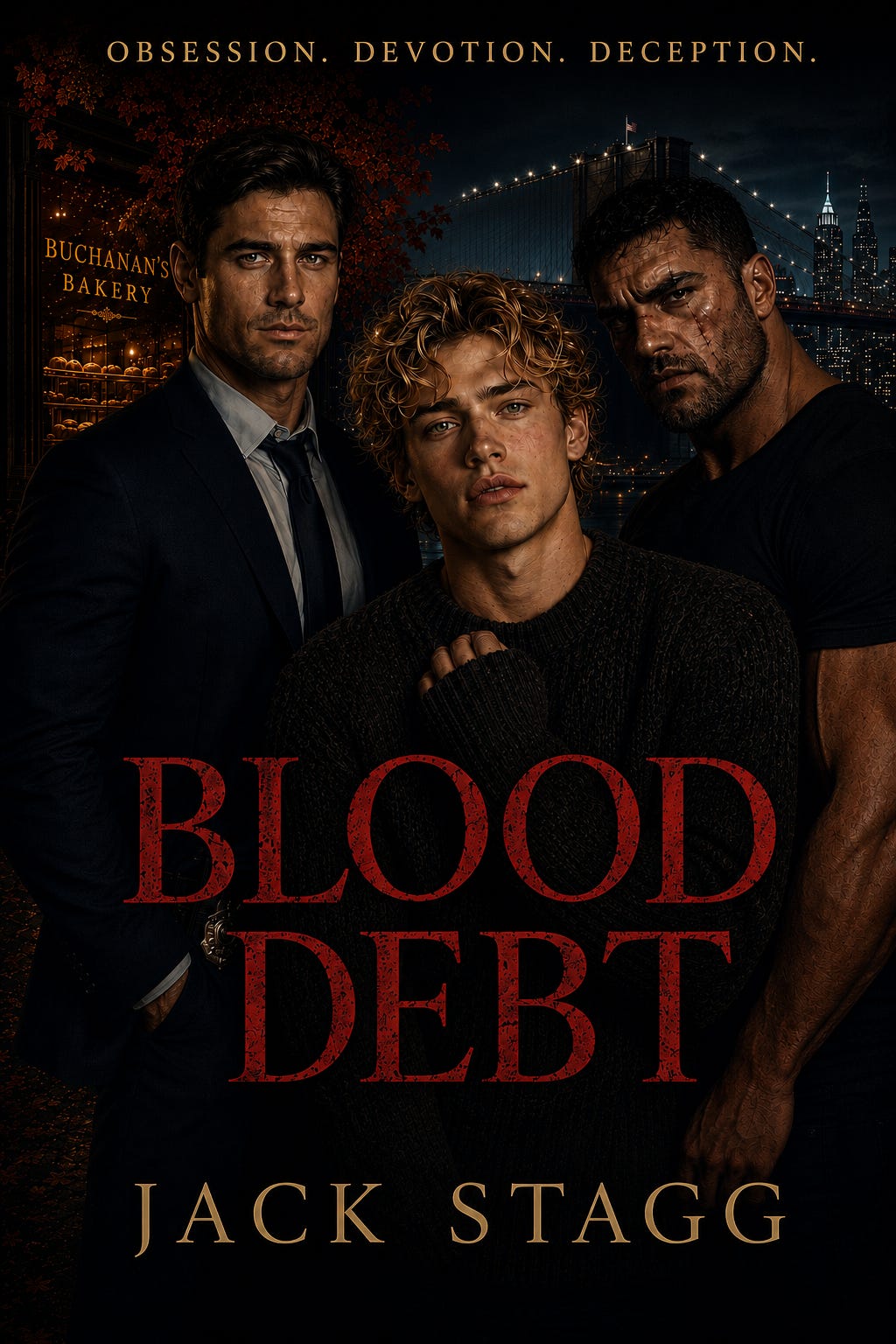
Brooklyn Methodist sat on the border of Park Slope and Cobble Hill, fourteen blocks from Buchanan’s Bakery, and it was the closest Level II trauma center to Degraw Street, which made it the only place the ambulance could have taken the scarred man.
Oliver hadn’t been inside a hospital in over a year. He’d avoided them like a recovering alcoholic avoids the bar where he used to drink. Pharmacies were fine. Doctor’s offices, manageable. But hospitals were a different thing. Hospitals were the country Oliver had been exiled from, and crossing the border, even as a visitor carrying a paper bag from his own bakery, required courage he wasn’t sure he’d earned.
He stood on the sidewalk for a moment. The building rose above him, gray and institutional. Ambulances were parked in a bay to his left, their back doors open, the EMTs between calls leaning against the bumpers with coffee cups and hollow eyes. A woman in scrubs pushed through the main entrance talking fast into her phone. A man in a wheelchair sat near the sliding doors, an IV pole beside him, his hospital gown fluttering in the October wind while he smoked a cigarette and dared anyone to say something about it.
The smell hit him first when he walked inside, that specific institutional scent that every hospital on earth apparently ordered from the same catalog, pine-based floor cleaner laid over the astringent bite of disinfectant, laid over something fainter and harder to name, something that the cleaning products were designed to make you forget was there. Oliver’s limbic system registered it before his conscious mind caught up, and for a disorienting half-second he was twenty-three again, badge on his lanyard, sneakers squeaking on linoleum, coffee in one hand and a patient chart in the other, heading toward a shift that would last fourteen hours and feel like four.
He blinked and the feeling passed. He was holding a bakery bag, not a chart. He was wearing corduroys and suspenders, not scrubs. He was a visitor, not a doctor.
But his feet still knew where to go.
He passed the main reception without stopping — the volunteer at the desk was occupied with an elderly couple and their complicated insurance question, and Oliver didn’t need her. He knew the anatomy of hospitals with the same intimacy he knew the anatomy of bodies, the logic of the layout legible to him not because of signage but because he’d spent years navigating identical corridors at three in the morning on no sleep. Emergency department on the ground floor, radiology adjacent, surgical suites on two, ICU on three, specialty wards above that. Every hospital was a variation on the same skeleton. You learned one, you learned them all.
He joined a small group at the elevator. A nurse in navy scrubs scrolling her phone. Two residents in white coats, young, tired, arguing quietly about a dosage Oliver could have corrected without looking up. A middle-aged woman clutching a bouquet of carnations and a Mylar balloon that said GET WELL SOON in aggressive yellow letters, her eyes red, her smile rehearsed. A father holding a toddler who was methodically peeling a sticker off a banana and placing it on the father’s jacket, one careful sticker at a time. The elevator opened on the fourth floor and Oliver stepped out, following the green signs hanging from the ceiling, until he reached the cardiothoracic surgery ward. The double doors were propped open. The nurses’ station sat just inside, a curved desk cluttered with monitors and charts and a half-eaten sandwich someone had abandoned next to a hand sanitizer dispenser.
Oliver approached the desk and a nurse looked up from her screen; mid-forties, reading glasses perched on the bridge of her nose, the permanent semi-frown of someone who had been interrupted six hundred times today and expected the six hundred and first to be no better. He gave her his best smile.
“Good morning, ma’am, “ he said. “How’s your day going?”
It was a small thing, but Oliver knew nurses. He’d worked beside them for years, had watched them hold entire wards together while doctors took the credit and patients forgot their names. They were the spine of every hospital and they were treated like furniture, and the fastest way to make a nurse’s face change was to look her in the eyes and ask about her day.
It worked. The semi-frown softened.
“Busy,” she said. “But thank you for asking. What can I do for you?”
“I’m hoping to visit a patient,” Oliver said. “Only I’m not sure which room he’s in.”
“Sure, I can look that up.” She was already turning to her screen, fingers on the keyboard. “What’s the name?”
“That’s the thing.” Oliver let his smile turn sheepish. “I don’t actually know his name. He’s — big guy, very big, early-thirties, had dark hair. Scar down the right side of his face.” He traced the line on his own cheek, from eyebrow to cheekbone. “He was brought in three days ago with a tension pneumothorax. I’m guessing he came through your ER.”
The fingers paused on the keyboard. Something shifted in the nurse’s expression. The reading glasses came down half an inch, Oliver could see her placing it: the big scarred man, the bakery, the article that had apparently made its way through every break room in Brooklyn.
“Sir, if you’re press, I need to let you know that we have a strict policy regarding—”
“No, no, God, no.” Oliver laughed, easy and warm, both hands raised in surrender. “I’m not a journalist. I promise.”
Oliver paused to let his laugh settle and dropped his voice slightly, just enough to make the next sentence feel like something offered rather than announced.
“I’m the one who performed the needle decompression. In the bakery. He collapsed in my shop and I — I just wanted to see how he’s doing.”
“You’re Dr. Buchanan?” The nurse’s face opened up. “Oliver Buchanan?”
Oliver did his best to hide the wince. The title preceding the name — Dr. Buchanan — still fit him like a coat he’d outgrown. The press had uncovered his identity within hours of the Post article. Two days of his phone ringing with numbers he didn’t recognize, journalists from outlets he’d never heard of wanting a quote, a comment, just five minutes of his time. Oliver only hoped the excitement around the story burned itself out before someone dug deep enough to discover why Oliver Buchanan no longer had the letters M.D. attached to his name.
“Just Oliver, please,” he said, smiling.
“That was an exceptional needle decompression, Doctor,” the nurse said, ignoring him completely. She’d taken her reading glasses off now, looking at him properly, reappraising. “The whole department’s been talking about it. Even Dr. Gupta was impressed, and trust me, that woman has seen everything and is moved by nothing.”
“That’s very kind. Thank you.” Oliver let the compliment land, held it for a beat, then leaned forward slightly. Just two medical professionals sharing a counter. “Listen, I completely understand the hospital’s policy on patient information. I’m not asking you to tell me anything you can’t. I just want to know where his room is. I’ll ask him everything else myself.”
The nurse bit her lip. Her eyes swept the corridor behind Oliver, left, right, a quick check that had nothing to do with caution and everything to do with the habit of someone who had been reprimanded for sharing patient information at least once before. Then she leaned forward, closing the distance between them, her voice dropping.
“You can’t, actually,” she said. “He discharged himself. Thursday morning, less than eighteen hours after he came in.”
Oliver stared at her. “That’s not possible.”
“I assure you it is.”
“He had a traumatic pneumothorax with tension physiology. He needed a chest tube, imaging, at minimum forty-eight hours of observation for re-expansion complications. You can’t just — he had a collapsed lung.”
“Dr. Buchanan, you are preaching to the choir.” The nurse straightened slightly, the camaraderie between them solidifying into something closer to shared professional outrage. “Every nurse on this ward tried to talk him out of it. Dr. Gupta sat with him for twenty minutes explaining exactly what could go wrong if the lung didn’t fully re-expand. Do you know what he said?”
Oliver shook his head.
“Nothing. He just looked at her until she stopped talking. Then he asked for the AMA papers.” She shook her head too. “I’ve been doing this for nineteen years, Doctor. I’ve seen patients leave against advice before. They argue with you, you know, get defensive. They make excuses. This man didn’t do any of that. He just decided he was leaving and that was the end of the conversation.”
Annoyance burned inside Oliver’s chest. He had improvised a procedure that should have been performed in a trauma bay by a team of three, and he had done it alone, with kitchen tools and bourbon, and that idiot, that enormous, reckless, stupid idiot; had waited less than a day before undoing all of it.
He thanked the nurse for her time and slid the paper bag across the counter, a pair of croissants he’d baked that morning, still faintly warm, wrapped in the bakery’s wax paper. They’d been intended for the man, but since he had apparently decided that modern medicine was a suggestion he could decline at his leisure, Oliver figured the nurse had earned them more than he had. She opened the bag, looked inside, and her entire face changed. Oliver liked that. He always liked that.
He stepped back from the desk, but before he could get far, he stopped and turned back again.
“One more thing,” Oliver said. “Can you at least tell me his name?”
Something almost apologetic crossed her face.
“He didn’t give one. Checked in as a John Doe, signed the AMA papers as a John Doe, and walked out the door as a John Doe. Whoever he is, he’s as stubborn as he is large.” She bit into one of the croissants and closed her eyes briefly. “And these are extraordinary.”
—
Journalists weren’t the only ones interested in Buchanan’s Bakery after the video of Oliver saving the scarred man’s life went viral. It started simply enough, with people flocking to Google to leave five-star reviews — complimenting Oliver’s heroic deeds, praising the bakery they’d never actually visited, and leaving comments that ranged from genuinely touching to deeply unhinged. “Went in for a croissant, confident that if I choked on it, the owner would perform an emergency tracheotomy with a butter knife. 5 stars., and “Best bakery in Brooklyn. Also apparently a Level 1 trauma center. Would recommend for pastries AND life-threatening emergencies.” and Lily’s personal favorite: “The sourdough is great but I’m mostly here because the hot baker who does surgery might be the most attractive man alive. I would collapse in this bakery on purpose. 5 stars.”
It became their morning tradition. Lily would pull up the latest batch of reviews on her phone and read them aloud to the bakery, giving each one its own voice and dramatic pause, to the great delight of Meredith, who contributed commentary from her window seat between crossword clues, Cal, who had started arriving earlier specifically so he wouldn’t miss the readings, and Camille Zamora, the copy editor who loved lavender honey lattes and had, as Oliver suspected, become a fully committed regular. Oliver found the whole thing absurd, being treated as a hero for doing the only thing his training had allowed him to do, but he wasn’t going to complain about five-star reviews, so he endured Lily’s performances and refilled the pastry case and said nothing.
And then Aria Cardenas, who wrote the food column for The New Yorker, walked through the door. She sat at the counter with the menu open in front of her and didn’t look up for four full minutes, and Oliver could tell from across the room that she was reading the ingredients listed under each item. To Oliver’s enormous relief, she didn’t seem remotely interested in scarred men or needle decompressions.
Oliver gave her a tour of the kitchen. She asked about his flour sourcing and the hydration ratio on his sourdough. She wanted to know why he cold-proofed for eighteen hours instead of twelve, and where he sourced the butter for his croissants, and how long he’d been maintaining his grandmother’s starter, and what temperature he kept the bakery’s ovens at during the first steam phase of the bread bake. Oliver answered everything. Trevor had told him that once his voice changed when he talked about baking, as if the rest of his life fell away and all that was left was flour and heat and the thing his hands knew how to do. He lost track of time. They talked for almost two hours.
He thought the interview was going well. Then he let Aria try the brown butter financiers, his favorite thing on the menu, the recipe he’d spent four months perfecting until the edges had exactly the right amber lacework and the centers stayed impossibly dense and moist; and the tahini miso chocolate chip cookies, which even Oliver’s harshest critics (Lily, when she was in a mood) had conceded were the best in New York. Aria bit into the financier first. Chewed slowly, closed her eyes, opened them. Bit into the cookie then and chewed even slower. She set it down on the plate and stared at it for a moment as if it had personally offended her by being that good. Then she looked at Oliver and said, very quietly, “Who the hell are you and why haven’t I been here before?”
Aria’s article ran one page only, tucked into the back half of the magazine, with just a small teaser on the cover: “The best-kept secret in Brooklyn isn’t a speakeasy. It’s a bakery on Degraw Street.” A photographer had come the following day, positioned Oliver and Lily in front of the big window with BUCHANAN’S BAKERY in gold lettering behind them and told them to stand close and not think too hard about smiling, which was easy for Lily and required effort from Oliver. But Aria’s words… Oliver read the article standing behind the counter before the bakery opened, and his hands went still on the page.
“The brown butter financiers are, without exaggeration, the finest I have eaten in this city. The edges achieve a caramelized lacework that most patisseries would sell their La Marzocco for, while the centers remain dense and almost obscenely buttery. Oliver Buchanan bakes with the precision of a scientist and the instinct of someone who has been touching dough since before he could read. That these come from a kitchen the size of my bathroom, operated by two people who are clearly insane enough to love what they do, makes them not just delicious but miraculous.”
Oliver read it a thousand times, then he took the single page, carried it to the framing shop on Atlantic Avenue, and had it mounted in a slim black frame. He hung it on the bakery wall next to the photograph of their parents — Oliver and Lily, just two identical kids grinning identical gap-toothed smiles, held in the arms of Erin and Ted Buchanan, who were squinting into summer sunlight and looking like the happiest people on earth. When Lily teased him about it, Oliver didn’t bother getting embarrassed. The only other time he’d felt this proud of himself was the afternoon he’d performed his first solo surgery, nothing dramatic, a straightforward appendectomy under the careful eyes of Dr. Wesley Krueger, the general surgery attending who had let Oliver close by himself for the first time and then nodded once, which from Krueger was the equivalent of a standing ovation. Oliver had walked out of that OR feeling like he could do anything. Like his hands had found the thing they were for.
He’d forgotten what that felt like.
After that, it exploded. First came the TikTokers, armed with ring lights and tripods and phones mounted on selfie sticks, setting up at the tables and filming themselves taking that first bite of financier with expressions calibrated for maximum viewer engagement. Then came the families, mothers with strollers wedged between tables, toddlers leaving fingerprints on the pastry case glass, fathers standing in line scrolling their phones while their kids pressed their faces against the display and pointed at everything and asked for all of it. Then the college students, groups of three and four crammed into tables meant for two, sharing a single financier between them because they couldn’t afford one each but had taken the subway from Bushwick specifically to try it, then the couples on dates, the food bloggers with their DSLRs, the older women who’d clipped the New Yorker article and brought it folded in their purses, the suited professionals who detoured from their commutes and ate standing up because there were no seats left.
On the third day after the article, Oliver came downstairs at five in the morning to start the bake and found a line already forming on the sidewalk. By seven there were thirty. By nine the bakery was at full capacity and it stayed that way, a constant, rotating stream of bodies filling every table and every inch of counter space, the line outside snaking past the maple tree and down the block. Oliver and Lily worked without stopping. Oliver baked and baked and baked, doubling batches, tripling the financier recipe, pulling trays from the oven and watching them empty before they’d cooled. Lily handled the front, the register, the crowd, her voice getting hoarser by the hour but her energy never flagging, because Lily had been made for exactly this kind of chaos.
By four in the afternoon, they had nothing left. The display cases were bare. The cooling racks were empty. The sourdough was gone, the croissants were gone, the financiers had sold out before noon and the second batch had sold out by two. Oliver stood behind the counter and looked at shelves that had never once been empty at four o’clock and felt something he couldn’t immediately name. They closed early. Lily flipped the sign and locked the door and leaned against it and slid to the floor and started laughing. Oliver sat down beside her. They stayed there for a while, shoulder to shoulder on the bakery floor, too exhausted to move, listening to the sound of people outside reading the CLOSED sign and groaning.
Oliver hadn’t seen Lily laugh like that in a while.
He sat beside her on the bakery floor, his back against the door, his legs stretched out in front of him, and watched his sister laugh with her whole body. It was a beautiful sound. It was also, Oliver realized, a sound he’d been missing without knowing he’d been missing it.
He ran the math quietly. The dark circles had started — when? Three weeks ago now. The concealer a day later. The deflected questions, the phone she kept turning face down on the counter when Oliver walked past. Lily still smiled, still talked, still filled every room she entered with enough warmth and noise for three people. But the laughter had thinned somewhere along the way, like a flavor you’d reduced too far. You could still taste it, but something essential had cooked off.
And now here she was, sitting on the floor of their empty bakery on the best day of business they’d ever had, laughing the way she used to laugh, and Oliver felt relief that the sound was back, and a quiet alarm that its absence had lasted long enough for the return to feel like an event.
Oliver watched her and almost asked. The question was right there, are you okay, Lil? really okay?, pressing against the back of his teeth. He could ask, he could push past the redirects and the bright pivots to pumpkin cardamom loaves, and Lily would probably tell him, because Lily had never been able to hold a secret when Oliver looked her in the eyes and asked directly. That was the difference between them. Lily’s secrets had doors that opened when you knocked. Oliver’s had walls.
He didn’t ask. And it wasn’t as if he didn’t care. Lily was the one person in his life whose happiness Oliver wanted for its own sake. But Oliver had his own secrets, rooms inside himself that Lily had never entered, that Lily didn’t even know existed, and he had kept them locked for years by respecting an unspoken principle between them: you don’t open doors you aren’t willing to have opened in return.
If Oliver demanded Lily’s truth, he was giving her permission to demand his.
Oliver couldn’t afford that.
“We need to talk about tomorrow,” Oliver said, once the laughter had settled into the occasional aftershock. “If this keeps up, we’re going to need to triple the overnight bake. And we’re almost out of the high-extraction flour — I’ll need to call the supplier first thing.”
They sat on the floor for another twenty minutes, too tired to stand, talking through the logistics. More butter, twice their usual order. Whether to add a second financier batch to the morning schedule or just increase the existing one. The croissant dough needed to start proofing earlier if they were going to meet demand. Lily suggested hiring part-time help for the front and Oliver said he’d think about it, which they both knew meant no, because Oliver didn’t like strangers in his space but would eventually come around when his body forced the concession.
Oliver’s phone had been in his hand the whole time. He’d texted Trevor almost an hour ago — what time are you coming? Need to know when to start the lamb — and had been carrying the phone around since, waiting for the buzz, half-listening to Lily while the other half of his attention sat on the silent screen. The phone buzzed.
(16:37:02) Can’t make it tonight gorgeous. Something came up, can’t get out of it. Sorry.
He even added a little sad emoji at the end. Oliver waited to reply, not too long, four minutes, maybe five. Enough time that it didn’t look like he’d been sitting on the bakery floor with his phone in his hand waiting for Trevor to remember he existed, but not so long that Trevor would think Oliver didn’t care. The calibration was automatic by now. Oliver didn’t even think about it anymore.
(16:41:47) Noooo. Everything ok? I don’t mind if you come a little later than usual
He set the phone on his thigh and turned back to Lily, who was in the middle of explaining her theory that they should offer a limited daily batch of financiers to create scarcity and keep people coming back. It was actually a good idea. Oliver told her so and they spent the next few minutes discussing the numbers, how many per batch, what to charge, whether to post the daily count on social media.
Lily’s eyes drifted to his phone screen when it lit up. Oliver noticed her noticing. She looked away quickly, back to the conversation, but the glance had been there.
(16:43:11) Just work stuff. Nothing interesting, I promise. Gonna be stuck here until late though. I’ll make it up to you this weekend ok? Miss you gorgeous
(16:44:27)No worries. Get some rest. I’ll save you leftovers
He added a red heart emoji, then erased it, then thought about it for a second, added it back, and hit send. Oliver wasn’t feeling like a red heart emoji. He was feeling — well, to use a language Trevor would understand — pissed.
Work stuff. Oliver turned the phrase over. Trevor was a specific man. Specific about his cases, his schedule, his frustrations. When he had paperwork keeping him late, he said paperwork. When he was driving to Long Island to chase down a witness who’d stopped returning calls, he said that. When Jonny needed him to sit in on an interrogation, Oliver heard about it in detail, usually with Trevor’s commentary on Johnny’s technique included free of charge. Trevor narrated his job to Oliver like a TV show: episode by episode, scene by scene, with updates Oliver hadn’t asked for and didn’t mind receiving.
Trevor only went vague when it was the other part of the job. The social machinery. The dinners with senior brass, the NYPD Widows and Orphans Fund benefits, the cocktail receptions at One Police Plaza, the galas held at City Hall where men in dress blues shook hands with men in politics and pretended the relationship was more noble than it was. All occasions where it would be perfectly reasonable, expected, even, for a detective to bring a partner. Oliver stared at the phone in his hand. Gonna be stuck until late. Stuck where? Not the precinct. Somewhere else, somewhere Trevor didn’t want to name because naming it would force him to explain why Oliver wasn’t invited, and explaining that would force him to confront the thing they both knew and neither of them said: that Oliver was the man Trevor slept with and was cooked for and whispered always to in the dark, but not the man Trevor stood next to in public. Not the man Trevor introduced to colleagues. Not the man Trevor took to galas.
Because they weren’t dating. Right?
“Damn,” Lily said beside him. “What did Hot Cop do this time?”
Oliver looked at her. “What?”
She nodded at his hand. “You’re about to break your phone, Ollie.”
Oliver looked down. His fingers were wrapped around the device so tightly the knuckles had gone white. His hand was trembling. Something hot and old and completely unrelated to sadness was sitting behind his sternum, coiled, pressing outward against his ribs. He relaxed his grip, one finger at a time. Get yourself together. Lily was right there. Lily was watching him with her head tilted and her eyebrows raised and her twin-radar fully operational, and Oliver could not — could not — let whatever was happening inside his chest reach his face. He breathed. Found the smile. Put it on.
“Nothing,” he said. “He just can’t make it tonight. Work thing.”
“A work thing,” Lily repeated, and the flatness in her voice made it clear exactly what she thought of Trevor’s work things.
“It’s fine.”
“You know what I think about—”
“I know what you think, Lil.”
“I’m just saying—”
“It’s fine.”
“Oliver.”
“It’s fine, Lily.”
“It’s not fine. He promised you he’d come over, and now you’re sitting here squeezing your phone like you’re trying to juice it.” She pulled her knees up to her chest. “How many times has he done this?”
“He’s a detective. He’s busy. It happens.”
Oliver got up, pocketing his phone and heading toward the counter. The conversation was over. His body said so clearly, back turned, hands already reaching for the cleaning spray and the cloth. Lily, as usual, didn’t get the memo. She was on her feet and following him in seconds.
“It happens a lot, Oliver.”
“Lily.”
“I’m just saying — if Sam cancelled on me this often with nothing but ‘work stuff’ and a smiley face, I’d have questions.”
“It was a sad face, actually.”
Good, Oliver thought. Humor. Make her laugh. Redirect.
“Oh, well. That changes everything.”
Lily wasn’t laughing. She leaned against the counter beside him, positioning herself exactly where Oliver couldn’t avoid her without making it obvious he was avoiding her. She’d been doing this since they were children, planting herself in the path of Oliver’s retreats, refusing to let him leave a conversation just because he’d decided it was over.
“When’s the last time he took you out somewhere, Ollie? Somewhere real. Not your apartment. Not his apartment. Somewhere with other people and daylight.”
Oliver wiped the counter. The cloth moved in slow circles. He knew the answer. He knew Lily knew he knew the answer. The silence was doing the work for both of them.
“I hear you,” Oliver said. You’ve made that perfectly clear, he thought, but he kept that part to himself. “And I’m not saying you’re wrong, okay? Just — it’s complicated.”
Good. Don’t get defensive. Throw her a bone. Agree with her a little — it’ll disarm her faster than digging in. Oliver had learned a long time ago that the quickest way to end a conversation he didn’t want to have was to give the other person the feeling they’d been heard. Resistance invited persistence. A small concession invited retreat.
It worked. Lily’s shoulders came down a fraction.
“I’m not trying to be a bitch,” she said. “I just worry, Ollie. That’s all. I want you to be happy.”
“I know.” Oliver reached across the counter and caught her fingers, squeezing once. “But you don’t have to worry about me. Look at me. I’m a big boy now. I can take care of myself.”
Lily snorted. “Since when?”
“Hey, I’ll have you know that—”
The small bell above the door chimed. On the periphery of his vision, Oliver saw the door swing open, the October air pushing in behind it.
“Sorry, sir!” Oliver called out, not looking up yet. “We’re closed for the—”
The words died in his throat.
The man standing in the doorway filled it completely, his shoulders nearly touching both sides of the frame, his head almost touching the top. He was bigger than Oliver remembered, or maybe it was just different, seeing all that mass upright and moving instead of collapsed on a bakery floor. The scar carved down the right side of his face, vivid and white against tanned skin. And his eyes, dark, almost black, clear and focused in a way Oliver had never seen them, were looking directly at him.
Oliver realized he’d stopped breathing.
“Really?” the man said, and his voice rolled through the empty bakery like distant thunder. “Even for me, Doc?”
—
He’s back. He’s awake. And he’s going to change Oliver’s life forever. That’s all I’m going to say.
Paid subscribers keep Blood Debt and Happily Ever After alive. Your support means everything to mee. See you next week.
I thought that we were going to learn Trevor’s secret in this chapter! ARGH!!!!
You’re keeping me on the edge of my seat, Jack! Great writing as usual. 🙂
So good, Jack! Stupid Trevor cheating on Ollie the same day John Doe walks in the door. 😂😜