
Blood Debt - Chapter Five
Gay Erotica; Dark Romance; +18, No-Cuckolding

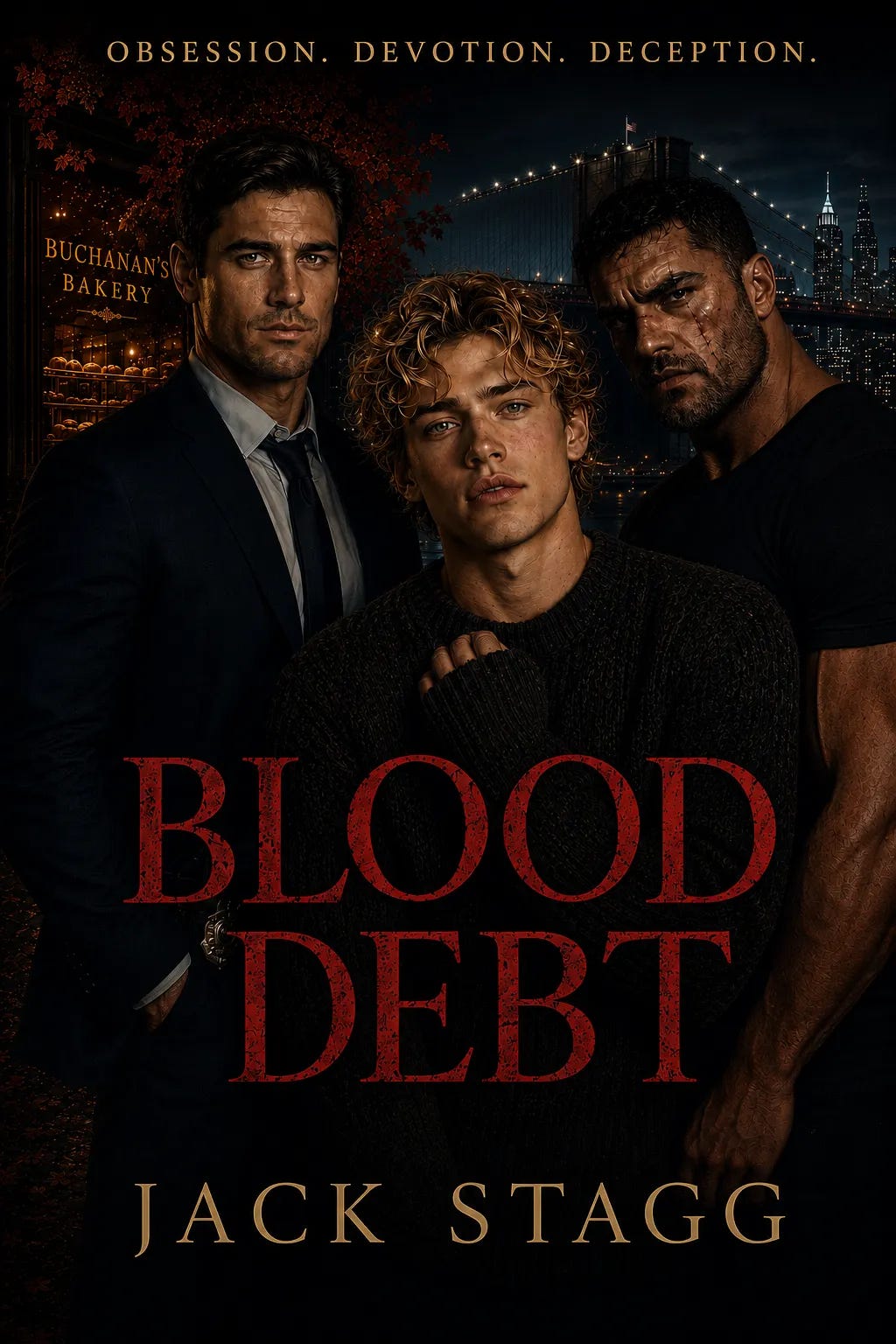
“Even for me, Doc?”
Oliver watched as the man stepped inside. The doorframe released him and the bakery received him, and the proportions of the room made their adjustments quietly, the tables and chairs all quietly recalculating their relationship to the space now that something this large was standing in it. He was wearing jeans and an expensive leather jacket that contradicted the plain black t-shirt underneath. His boots made no sound on the hardwood, which should have been impossible for a man his size.
He stopped about six feet from the counter, looked at Oliver, and said nothing else.
Oliver recovered. The machinery came back online, the gears catching, the performance assembling itself from the parts that exhaustion and Trevor’s text had scattered across the floor.
“You really should be in a hospital right now,” he said.
“So I’ve been told.”
The voice was the same low rumble Oliver had heard from the doorway, carrying enough that you didn’t have a choice whether to listen to it. The man didn’t smile. He didn’t do anything with his face at all.
Oliver waited for more. More didn’t come.
“I went to Brooklyn Methodist to see you,” Oliver said, making his posture open, approachable. “They told me you’d discharged yourself. Against medical advice. Twenty hours after a tension pneumothorax.”
“Sixteen.”
“Excuse me?”
“Sixteen hours. They were rounding up.”
Oliver felt his jaw tighten. This man was giving him nothing. Two-word answers. Three-word answers. Silences that sat between them like furniture Oliver kept bumping into.
“You had a collapsed lung,” Oliver said.
“I know. You fixed it.”
“I stabilized it. With a marinade injector. In a bakery. You needed a chest tube and forty-eight hours of observation and you walked out before breakfast.”
The man looked at him. Those dark eyes hadn’t moved from Oliver’s face since he’d stepped through the door. They weren’t aggressive or challenging, they were just there, settled on Oliver with a weight that Oliver couldn’t redirect or charm his way around. Most people looked at Oliver and saw what Oliver wanted them to see. This man was looking at Oliver as if the performance wasn’t there.
“You always lecture your patients, Doc?”
“You’re not my patient. You’re a man who almost died on my floor and then decided it was a minor inconvenience.”
Something shifted in the man’s face, even less than that, a softening around the eyes. The ghost of amusement passing through features that didn’t seem built for it.
“I came to say thank you,” he said.
Three seconds of silence and Oliver realized he’d been waiting for the rest of the sentence. There was no rest of the sentence. That was it. I came to say thank you. Six words and somehow they filled the room.
“If you wanna thank me, get back to Brooklyn Methodist and stay there until Dr Gupta discharges you.”
“I’m fine, Doc.”
Another three words, stated as if they were talking about the weather or the time, a fact so settled it didn’t require support. The conversation about the hospital was over, because the man had decided it was over, and Oliver could feel the door closing as clearly as if he’d heard the lock turn. He knew this feeling. He used it on other people constantly, immovable refusal to continue a conversation that had run its course. I’m fine. Oliver said those words to Lily, to Trevor, to anyone who got too close to a door Oliver wanted shut. He said them warmly, with a smile, wrapped in enough softness that the other person barely felt the wall go up.
The man didn’t bother with the wrapping. He just put the wall up and stood behind it and looked at you with those dark eyes and waited for you to find something else to talk about.
Oliver would hate to disappoint him.
“Look,” he said, and he was aware of how clipped he sounded, how the warm bakery-owner voice had been replaced by something closer to the tone he’d used on the floor with a dying man. “A tension pneumothorax means air got trapped in your chest cavity and compressed your lung. I released the pressure, but the underlying injury,the rib fracture that caused the puncture, is still there. If that lung doesn’t re-expand fully, if there’s even a partial recurrence, you could go into respiratory failure—”
“I’m Lily,” said Lily.
Oliver almost jumped. Had he really forgotten she was there with them? Had he been so locked into the man in front of him, that Lily had simply ceased to exist in his peripheral awareness? That hadn’t happened before. Oliver was always aware of the room. Always.
For the first time since he’d walked through the door, the man’s eyes left Oliver’s face. He looked at Lily.
“Joey,” he said.
Joey. Oliver turned the name over in his mind. It didn’t fit him. It was too light for all that mass, too casual for that face. A boy’s name on a man’s body.
“You owe us a table.”
The ghost of amusement again, closer to the surface this time. “I’ll replace it.”
“And a candle.”
“And a candle.”
His eyes returned to Oliver. Just like that, Lily’s entire presence dismissed in the space between one breath and the next, as if she’d been a brief interruption in a conversation Joey was eager to resume. Oliver couldn’t help noticing, because men did not get over Lily Buchanan that simply. Oliver had spent twenty-seven years watching it happen. Men met Lily and something in their brains stuttered. Their voices changed. Their posture changed. They found reasons to keep talking, keep looking, keep orbiting. Lily was beautiful in a way that was also warm, and that combination was a gravity that most men couldn’t resist and didn’t want to. Joey had looked at her, answered her, and turned back to Oliver as if the gravity didn’t apply to him. As if the only thing in this room that held his attention was the man behind the counter.
Lily must have noticed too, because something flickered across her face, not offense and not quite surprise, more like a recalculation, before she wiped her hands on her apron.
“I’m going to finish cleaning the kitchen,” she said. “Oliver, offer the man a coffee. He came all this way.”
She disappeared through the kitchen door and Oliver and Joey were alone in the empty bakery.
The silence that followed was unlike any silence Oliver had experienced. Oliver didn’t like silences. He’d learned early that when people weren’t talking to him, they were usually thinking, looking deeper than he felt comfortable with, and that was something he couldn’t afford. Silence gave people room to notice things.
Oliver turned and walked to the espresso machine, Joey’s eyes following him the entire way. He reached for the coffee beans and his hand hovered for a moment over the house blend, decent at best, because he was not about to waste the single-origin Ethiopian he’d been saving on an idiot who treated his own health as an afterthought. Then he caught himself being petty. The man could technically drop dead at any moment from a re-collapsed lung. He deserved good coffee before that, at least.
“So,” he said, spooning the Ethiopian beans into the grinder. “How does someone with a tension pneumothorax end up taking a walk through Brooklyn?”
“Can’t really tell you.” Joey’s voice came from the same spot. “Don’t remember a lot from that morning. I remember it getting hard to breathe. I remember a door.”
“My door.”
Oliver pressed the grinder and the sound filled the bakery for a few seconds. When it stopped, the silence returned, and Joey was still looking at him.
“Your door,” Joey agreed. “Maybe it was fate.”
“You don’t strike me as the kind of man who believes in fate.”
“I’m not.” Joey shrugged, a small motion that moved an enormous amount of shoulder. “But what else do you call it? Walking into the one shop in Brooklyn run by the only man who could’ve saved my life.”
“I’d call it a very happy coincidence,” Oliver said, tamping the grounds into the portafilter and locking it into the machine. “And one you probably won’t be lucky enough to have again if that lung gives out on you a second time.”
The espresso machine hissed and the dark stream filled the cup. Oliver focused on it, the color, the crema forming on the surface, the amber that told him the extraction was right. Even annoyed, even arguing with a wall of a man who wouldn’t listen to basic medical advice, Oliver couldn’t bring himself to pull a bad shot.
“I got a guy. Don’t worry about it.”
Oliver set the cup on the counter between them. The crema was perfect. He resented it slightly.
“If he’s the same guy who set your nose, that’s not very reassuring.”
This time, Joey smiled, and it changed his entire face. The heavy brow lifted, the jaw softened. The scar was still there but it stopped being the first thing you saw, because the smile rearranged everything around it — pulled the severity out of those dark features and replaced it with something warm and startled and almost boyish, as if the smile had surprised Joey as much as it had surprised Oliver. He looked ten years younger. He looked like someone you’d want to sit next to. He looked like someone who had been told a joke by a person he hadn’t expected to be funny, and that was better than any joke.
Oliver’s hands stopped on the espresso machine.
Joey, whoever he was, was a man who should really smile more.
“Two different guys, actually,” Joey said, still smiling. He reached for the little paper packets of sugar by the register, tore one open, and dumped the entire contents into the espresso. Then did it again. And again. “I’ll let them know their work fell below the standards of Dr. Buchanan.”
Oliver almost managed not to flinch, but he was fairly certain Joey had caught it anyway. Those dark eyes didn’t seem to miss much.
“You do that,” Oliver said. “What about you? You’re Joey...?”
“Just Joey.”
He took a sip of the coffee and his eyebrows rose a fraction.
“Damn,” he said quietly. “That’s good.”
“I’d appreciate it more if you hadn’t just drowned it in three packets of sugar,” Oliver said, and Joey smiled again. Twice in two minutes. Oliver was keeping count without meaning to. “Tell me, Joey what? You know my name. It’s only fair.”
Joey set the cup down, looked at Oliver for a moment, considering, as if deciding how much of himself to put on the counter alongside the coffee.
“Knight,” he said. “Joey Knight.”
“Well, Joey Knight. If you wait a few minutes, I can put together some biscotti to go with all that sugar. Since clearly we’ve given up on health entirely.”
For a second, Joey actually seemed to consider it, a barely visible pull toward the empty pastry case passing through his face. Oliver was starting to suspect the man had a sweet tooth, which was absurd and somehow entirely right for someone built like a concrete wall.
“Nah. Don’t bother.” Joey finished the coffee, set the cup down “Can’t stay. I really just came to say thank you for saving my life.”
He looked at Oliver, his eyes finding Oliver’s and staying there, and the quality of his gaze changed. It was as if the rest of the bakery had been quietly asked to leave the room. The Edison bulbs and the chalkboard menu and the empty pastry case and the maple tree outside the window — all of it receded until there was nothing left but the small distance between the counter and the man standing on the other side of it.
“I mean it, Doc.” Joey’s voice was low. “I won’t forget.”
Oliver felt heat climb the back of his neck.
“You’re welcome,” he said. And meant it. Oliver reached for his phone on the counter. “Give me your number. I want to check in over the next few days, make sure you’re not dead in a ditch somewhere.”
Joey looked at the phone. Then at Oliver. He didn’t reach for it.
“Trust me, Doc,” he said, and started toward the door. Those heavy boots still making no sound on the hardwood, which Oliver still found impossible. “This isn’t the last time you see me.”
The door opened. The October air came in. Joey Knight stepped through the frame — ducking, Oliver noticed again — and the bakery released him into the evening. The door closed. The bell chimed once, a small bright sound that had no business being the last note of this conversation. Oliver stood behind the counter, his phone still in his hand, the empty espresso cup sitting between them with its three packets of sugar torn open beside it. The bakery was quiet.
Joey returned the next morning.
Oliver hadn’t been expecting him. There was a part of him that had been sure he would never see Joey Knight again, that he’d spend the rest of his life occasionally wondering what had happened to the enormous stubborn man whose life he’d saved. Just another strange story from the bakery, filed alongside the time a woman tried to pay for a croissant with a poem and the morning a pigeon got in and Lily chased it around the dining room with a broom for fifteen minutes.
He was behind the counter at 6:12 in the morning, restocking the pastry case, sliding the fresh financiers into their rows while the second batch of croissants proofed in the kitchen. The radio was on low, Nina Simone’s “Sinnerman,” the long version, all ten minutes of it, and he was enjoying the last of his coffee and the last of the stillness of a bakery before it becomes a bakery, when the light through the front window dimmed.
Oliver looked up from the pastry case — and there was Joey, standing on the other side of the glass door, filling it, blocking the entire frame and a good portion of the window beside it.
“We don’t open until seven,” Oliver said, despite doing exactly that, turning the lock and stepping aside to let Joey through.
“”I know. But you wouldn’t leave your favorite patient out in the cold.”
“You’re not my patient,” Oliver said. “And if you were, you definitely wouldn’t be my favorite. My favorite patients don’t discharge themselves against medical advice and vanish without a phone number.”
Joey shrugged. “Your favorite patients bring you gifts?”
Only then did Oliver notice the plastic bag hanging from Joey’s hand, white and thin with the logo of a Duane Reade stamped on the side. Joey raised it and held it out. Eyebrows raised, Oliver took the bag and reached inside. His fingers found glass — smooth, cylindrical, heavier than expected. He pulled it out.
A candle.
“To replace the one I broke,” Joey said. “I thought about getting you a table too, but I wasn’t sure it’d fit on the subway.”
Oliver snorted. He turned the candle in his hands and held it close to his nose. Vanilla, definitely, thick and sweet, and underneath it his nose picked up something that was trying very hard to be sandalwood but was closer to a pine air freshener that had been left in a hot car. It wasn’t what Oliver would have chosen, the vanilla was a little too sweet. But Joey Knight had walked back into his bakery holding a drugstore candle because Lily had mentioned, once, half-joking, that he owed them one.
“You shouldn’t have bothered,” he said, but he could feel himself smiling. He hadn’t expected this. “But thank you. I appreciate it. Come inside.”
He turned back into the bakery and felt Joey follow him. The man was still impossibly silent for someone his size, but Oliver was aware of him anyway, the presence of two hundred and seventy pounds moving through a room designed for people who weighed considerably less.
“Coffee?” he asked, going back behind the counter.
“Sure.”
Joey sat on one of the stools at the counter. The stool, which had comfortably held every customer Oliver had ever served, looked suddenly like something stolen from a kindergarten. Joey’s knees came up almost to the level of the counter and the wooden legs bowed slightly outward and Oliver watched the physics negotiate in real time with a concern he kept off his face.
“Maybe one of those biscotti you mentioned last night?” Joey said.
“How about a croque monsieur instead,” Oliver said, already reaching for the sourdough. “Gruyère, ham, bechamel, fried egg on top. You’ve already had enough sugar this week to put a horse into a coma.”
“I already ate.”
“And?”
Joey considered this for approximately one second. “Yeah, I could eat again.”
Oliver slid the croque monsieur into the oven to warm — Oliver Buchanan did not own a microwave, had never owned a microwave, and would sooner close the bakery than reheat anything with radiation — and turned back to the espresso machine.
“How do you take your coffee?”
“Latte,” Joey said. “Whole milk. Four sugars. Vanilla syrup if you got it. Whipped cream on top.”
Oliver’s hand stopped on the portafilter. He turned around slowly.
“You’re joking.”
“Never been more serious in my life, Doc.”
Oliver stared at him and Joey stared back, absolutely without shame.
“That’s not coffee,” Oliver said. “That’s a milkshake.”
“It’s how I like it.”
“Four sugars. On top of vanilla syrup. On top of whipped cream.” Oliver began counting on his fingers. “Do you have any idea how many grams of sugar that is? In a single cup?”
“No.”
“Would you like to know?”
“Not really.”
Shaking his head, Oliver turned back to the machine. He pulled the shot, a beautiful shot, golden crema, the Ethiopian beans wasted on a man who was about to drown them in dairy and sweetener. He steamed the milk, whole, because apparently they’d abandoned all pretense of moderation, and poured it over the espresso. Then the vanilla syrup that Oliver kept in a bottle behind the counter because some customers requested it, and every time he poured it he felt a small part of his soul leave his body.
“How much syrup?” he asked, already regretting the question.
“Three pumps,” said Joey, with no hesitation. “Nah, make it four.”
“I’m doing two.”
He added the whipped cream last. A generous mound of it, because if he was going to participate in this crime against coffee he might as well commit. He slid the cup across the counter. It looked like something a twelve-year-old would order at a mall food court. Joey picked it up and took a long sip. His eyes closed for a moment. When they opened, he nodded once.
“Good,” he said.
“I want you to know,” Oliver said, leaning against the counter, “that I used single-origin Ethiopian beans for that, hand-selected, small-batch roasted. They cost me forty-two dollars a pound. And you turned them into a Frappuccino.”
“A damn good Frappuccino, though.”
“Get out of my bakery.”
Joey almost laughed. The sound didn’t fully make it out, but his chest moved and the corner of his mouth pulled upward and something warm flickered behind those dark eyes. It was the closest thing to a laugh Oliver had seen from him.
Oliver pulled the croque monsieur from the oven and slid it onto a plate, then set it in front of Joey with a knife and fork placed neatly on the right side. Joey ignored both entirely. He picked the sandwich up with his bare hands, bechamel and melted cheese and all, and bit into it. One bite took a third of it. His eyes widened slightly, the most dramatic reaction Oliver had seen from him, and he chewed with an unselfconscious pleasure that Oliver found he genuinely approved of.
“Fuck,” Joey said, the word muffled by gruyère and sourdough. “This is good. What’s it called again?”
“Croque monsieur.”
“This is a fucking good croque monsieur, Doc.”
“Thanks,” Oliver said. He watched Joey take another enormous bite, the second third disappearing as efficiently as the first, and the remaining piece already looking nervous about its future. Oliver let him chew. Then he couldn’t help himself. “”How are you feeling? Any shortness of breath?”
Joey glanced up, mouth still full.
“Any pain when you take a deep breath?” Oliver kept going. “What about when you’re lying flat — are you sleeping on your back or have you been propping yourself up?”
“All good, Doc.” Joey finished the last third of the croque monsieur and wiped his hands on his jeans. “Told you. I got a guy.”
“Yeah, yeah,” Oliver said, already dismissing Joey’s guy.
He crouched below the counter and pulled out the first-aid kit, or rather, the updated version Oliver had assembled the previous night after closing the bakery. His old stethoscope was in there, the Littmann Cardiology he hadn’t touched in months, still in its case, the earpieces still molded to the shape of his ears. A pulse oximeter. A penlight. A manual blood pressure cuff. All things he’d kept in a drawer in his apartment, relics from another life that he couldn’t bring himself to throw away and couldn’t explain keeping. He’d transferred them into the kit after Joey left, telling himself it was just practical, just a sensible precaution for a bakery that had recently proven it could double as an emergency room.
He set the kit on the counter and unzipped it.
“Here. Let me listen to your chest.”
Joey looked at the stethoscope, then at Oliver. “You really don’t have to—”
“I do,” Oliver said. He was already coming around the counter. “Take off your jacket.”
Joey rolled his eyes with enough force that Oliver could almost hear it, but he did as he was told. He shrugged off the leather jacket, the same dark brown one from last night, and draped it over the counter. The black t-shirt underneath sat comfortably across his shoulders and arms. Oliver noticed this with a vague surprise he couldn’t immediately explain, and then realized: he’d been expecting tight. Most men built like Joey wore their shirts like compression garments, fabric straining across the chest and clinging to the biceps, every muscle outlined and announced. Trevor did it constantly, henleys and crewnecks that fit him like a second skin, the contours of his gym-built physique visible through the cotton at every angle. Oliver had always assumed that was just what big men did, that vanity and muscle were a package deal. Joey’s shirt just fit. It accommodated his enormous frame without advertising it, the fabric loose enough to move in, the sleeves ending at the middle of biceps that were thicker than Oliver’s thighs.
The effect, Oliver observed with clinical neutrality that was not entirely clinical, was somehow worse. Because the shirt didn’t show you what Joey looked like. It made you wonder.
“Excuse me,” Oliver mumbled.
He pushed the collar aside to access the chest and his fingers brushed skin that was warm and taut over dense muscle. The beginning of Joey’s pec came into view — muscular, covered in dark hair, and tanned several shades deeper than any New Yorker had a right to be in late October. Mediterranean, Oliver catalogued automatically. Italian, maybe Greek, somewhere along that coastline where the sun was generous and the men were built like stone walls.
“Breathe normally,” Oliver said.
He placed the diaphragm of the Littmann against Joey’s right chest, just below the collarbone. The stethoscope was cold and Joey didn’t flinch, which Oliver noted. He listened. Air moving, bilateral, clear and even on the right side. He shifted to the left, the side that had been silent two weeks ago, and pressed the diaphragm to the skin over the second intercostal space, almost exactly where he’d pushed the marinade injector through. He could see the scar from the incision, small and already healing. His own work, done with an eleven-dollar paring knife. Oliver felt a quiet satisfaction that he kept entirely off his face.
“Deep breath,” he said. “As deep as you can.”
Joey inhaled. The chest expanded under Oliver’s hand and the stethoscope picked up air entering the left lung — diminished compared to the right, still recovering, but present. Functional. Two weeks ago this lung had been compressed flat against the mediastinum. Now it was working again, which was more than Oliver had dared to hope for when he’d been kneeling on the floor with bourbon on his hands.
“Again,” Oliver said. “Slower this time.”
He was aware, throughout the examination, of Joey’s heat. It radiated off him the way the ovens in the kitchen radiated through the wall, constant, the warmth a byproduct of whatever engine ran beneath all that muscle. Standing this close, Oliver could feel it through the thin fabric of the t-shirt, against his own forearms, on his face when he leaned in to reposition the stethoscope. Joey Knight ran hot. Oliver filed this away alongside the sweet tooth and the silent boots and the dark eyes that missed nothing.
And his scent. Oliver hadn’t been prepared for that. Standing this close, with the stethoscope pressed to Joey’s chest and nothing between them but cotton and the thin column of air Oliver was trying very hard to keep professional, it was impossible to miss. Leather from the jacket, still clinging to the shirt. The warmth of his skin underneath, almost smoky. And then the cologne, subtle, and that wasn’t department store cologne. That was something richer, something with oud and amber and a dry woody finish that probably cost more per bottle than the jacket. It was cologne that men who sat on the boards of things wore to dinners where the wine was older than the waiters.
Oliver stepped back and removed the earpieces, taking a breath he hadn’t realized he’d been holding.
“Well?” Joey asked.
“You’re going to live,” Oliver said. “Through no fault of your own.”
Joey snorted.
“I want to check the incision site,” Oliver said, putting the stethoscope down. “Where I went in. May I?”
Joey gathered the front of his t-shirt and pulled it up to his chest, bunching the fabric under his chin, and Oliver stepped close again. The incision was on the left side, just below the collarbone. The edges had knit together neatly, the skin around it pink and new. No redness, no swelling, no heat when Oliver pressed two fingers gently beside it. No sign of infection. The stitches were small and even. Competent work.
“This is healing well,” Oliver said, his fingertips tracing the border of the wound. He could feel the heartbeat under his fingers, strong, pushing blood through the chest Oliver had opened. “I want to check the fracture too. Can you lift higher?”
Joey pulled the shirt up to his neck. The full torso came into view and Oliver’s clinical gaze did its job of assessing, cataloguing, moving on, while some other part of him, a part that had no business being involved in a medical examination, did not move on at all.
There was no sculpted definition in Joey’s body, no carved six-pack, none of the chiseled aesthetics that men like Trevor spent six mornings a week building in front of mirrors. Joey was thick, built in dense layers, heavy pectorals covered in dark hair, broad shoulders that rolled into arms corded with muscle, a stomach that was strong but carried its weight honestly, no vanity in it, just mass that had been earned and maintained through something harder than a bench press. The dark hair covered his whole torso and trailed down the center of his stomach, thickening below the navel before disappearing past the waistband of his jeans. His skin was olive and warm and marked — a short pale line across the ribs on the right side, a puckered circle on the left flank that Oliver’s training identified immediately and then made him pretend he hadn’t. Old scars. Healed scars. A body that had been opened before, more than once, and had closed itself back up every time.
Oliver found the fracture site by touch. Lower left lateral chest wall, seventh and eighth ribs. Joey’s skin was hot under his hands. The hair on his stomach was coarse against Oliver’s wrist as he worked.
“Does this hurt?” Oliver pressed slightly harder over the seventh rib.
“No.”
“This?” He moved to the eighth.
“Little bit.”
“That’s the fracture. It’s still setting.” Oliver kept his fingers there, feeling the irregularity in the bone beneath the muscle, mapping the break with his fingertips. He was close enough that the scent of the cologne and the leather and the warm skin filled his entire field. “You need to avoid heavy lifting for at least another—”
“Doc.”
Joey’s voice carried an odd note Oliver couldn’t immediately place.
Their faces were closer than Oliver had realized, a few inches, no more, close enough that Oliver could see the individual fibers of scar tissue crossing Joey’s cheekbone, could see the black of his pupils against the dark brown of the irises, could feel Joey’s breath warm on his forehead. Joey’s expression hadn’t changed. He was still, his body relaxed under Oliver’s hands, but something in those dark eyes had shifted, something Oliver couldn’t read, and Oliver could read everyone.
“Your hands are cold,” Joey said.
Oliver opened his mouth to respond —
The bell above the front door chimed.
“Ollie? I saw the light was on, so I — “
Trevor’s voice stopped. Oliver turned, his fingers still resting on Joey’s bare ribs, his face still inches from Joey’s chest, and saw Trevor standing in the doorway of Buchanan’s Bakery. Navy coat today, badge on his belt. Trevor’s eyes moved from Oliver’s face to Oliver’s hands to Joey’s bare torso to the space between them, and his expression went through three changes in the span of a single second, the last of which settled into something very still.
“Hey, Trev,” Oliver said, smiling warmly. “I wasn’t expecting you.”
“Thought I’d stop by,” Trevor said. His voice was easy but his eyes were still doing the math on the scene he’d walked into. He nodded toward Joey. “Morning.”
Joey had already fixed his shirt. He nodded back from the stool, unhurried.
“Morning.”
“Trev, this is Joey,” Oliver said. “He’s the guy who got sick in here a couple weeks ago.”
Trevor looked at Joey properly for the first time. The full assessment, height, weight, distinguishing marks, threat level, catalogued in under three seconds. Oliver had seen Trevor do it to strangers a thousand times.
“Shouldn’t you be in a hospital, man?”
Oliver snorted.
“Best care in town is right here,” Joey said. “Best croque monsieur, too.”
“Can’t argue with that.”
Oliver rolled his eyes. “Don’t encourage him, Trev. I’ve been trying to get him back to Brooklyn Methodist all morning.”
“You should listen to him, man. Ollie knows what he’s talking about,” said Trevor, though he didn’t sound that worried. “You mind if I pull Ollie away for a second?”
“Go ahead. I’m out of here anyway,” Joey said, already slipping back into his leather jacket. He looked at Oliver. “Thanks for the second breakfast, Doc.”
Oliver smiled at him. Apparently Joey had sense enough to read the room, to clock that Trevor was more than a friend and give them space without making the giving obvious. Oliver appreciated the grace of it. Most men that size didn’t bother with grace.
“You go easy on that rib,” Oliver said. “I mean it. No heavy lifting. No sudden movements. And if you feel any tightness in your chest—”
“I’ll come straight to the bakery,” Joey said. “Got it.”
He pulled his wallet from his jacket and placed a bill on the counter.
“Keep the change.”
Oliver looked down. “That’s a hundred.”
“Yep.”
“The coffee and the croque monsieur came to fourteen dollars.”
“Then you got yourself a nice tip, Doc.”
“Joey, I can’t—”
But Joey was already at the door, ducking through the frame. The bell chimed and then he was gone.
Oliver stared at the hundred-dollar bill on the counter.
“He left you a hundred?” Trevor was looking at the door where Joey had just disappeared. “For a coffee and a sandwich?”
“Apparently.”
“Huh.” Trevor turned back from the door and something was working behind his eyes. “Weird guy. What’s his deal?”
Oliver shrugged. “He came for breakfast.”
“And you were — what, giving him a physical?”
“Just checking his lungs, his incision. Making sure the idiot hasn’t undone all my hard work by walking around Brooklyn with a half-healed rib fracture.” Oliver moved closer to Trevor, closing the distance between them. “Why are we still talking about him when you haven’t kissed me yet?”
Trevor’s face softened. The cop brain powered down and the man Oliver knew came back, all warm eyes and easy grin, hands finding Oliver’s hips and pulling him in. They kissed. Trevor tasted like toothpaste and cold October air.
“That was a nice surprise,” Oliver murmured against his mouth.
“Missed you last night.” Trevor’s thumb traced a circle on Oliver’s hip through his apron. “Thought I’d come say hi before my shift.”
“Good thinking, Detective.”
They kissed again, slower this time, Trevor’s hand sliding up Oliver’s back. Oliver let himself have it, the warmth and the familiar comfort of a man who drove across Brooklyn at six-thirty in the morning because he felt guilty about a cancelled evening. The annoyance Oliver had felt the night before had vanished. Oliver was, in fact, in a surprisingly good mood.
“How was your thing last night?” he asked.
“Boring as hell,” Trevor said. “Should have ditched those assholes and come here instead.”
“Yeah,” Oliver said, bumping his forehead gently against Trevor’s chin. “You really, really should have.”
Trevor left at quarter to seven, one last kiss at the door, the badge catching the early light. Oliver watched him cross the street to the Charger, watched him wave once without turning around, as if looking back would make leaving harder, and then the car pulled away and the street was quiet again.
Oliver turned back to the bakery. There was work to do.
He cleared Joey’s plate and coffee cup from the counter. Washed both. Wiped down the stool. Swept the crumbs. The hundred-dollar bill went into the register, and Oliver made a mental note to argue about it the next time he saw Joey, which, if “this isn’t the last time you see me” was anything to go by, would probably be soon. He checked the proofing trays in the kitchen. Pulled the second batch of croissants from the oven. Loaded the pastry case. Refilled the coffee beans. Wiped every surface twice because Oliver always wiped every surface twice. By the time he unlocked the front door and flipped the sign from CLOSED to OPEN, there were already eleven people in line outside, bundled in scarves and October coats, breath visible in the cold air, waiting for the bakery that the New Yorker had told them was worth the trip.
Oliver smiled at the first customer. The machinery was running. The day had begun.
He was heading back behind the counter when his eye caught the Duane Reade bag, still sitting where he’d left it, crinkled white plastic with the faded blue logo. With the candle in his hands, he started toward the display tables, where the votives sat in their glass holders, one on each table, lit every morning, blown out every evening, because his grandmother had taught him that a candle in the window meant someone was home.
Oliver stood there for a moment, looking at the tables without really seeing them. Then he turned and walked to the back staircase that led up to his apartment, crossed to his bedroom, and set the candle on his nightstand.
He looked at it for a second, then he went back downstairs. There were customers waiting.
—
A vanilla candle from Duane Reade. On the nightstand. If you know, you know. If you don’t know yet, keep reading. Next week: Joey comes back. And back. And back.
If you're enjoying Blood Debt, becoming a paid subscriber is the best way to support my work and keep the chapters coming.
Trevor can fuck off. I'm already in love with Joey.
I'm hoping that Joey will help Oliver get back to his medical career, and do something evil to Colby Davenport and his family. I haven't decided how I feel about Trevor yet - maybe he'll get jealous of Joey and realize he'd better not fuck up his relationship with Oliver!